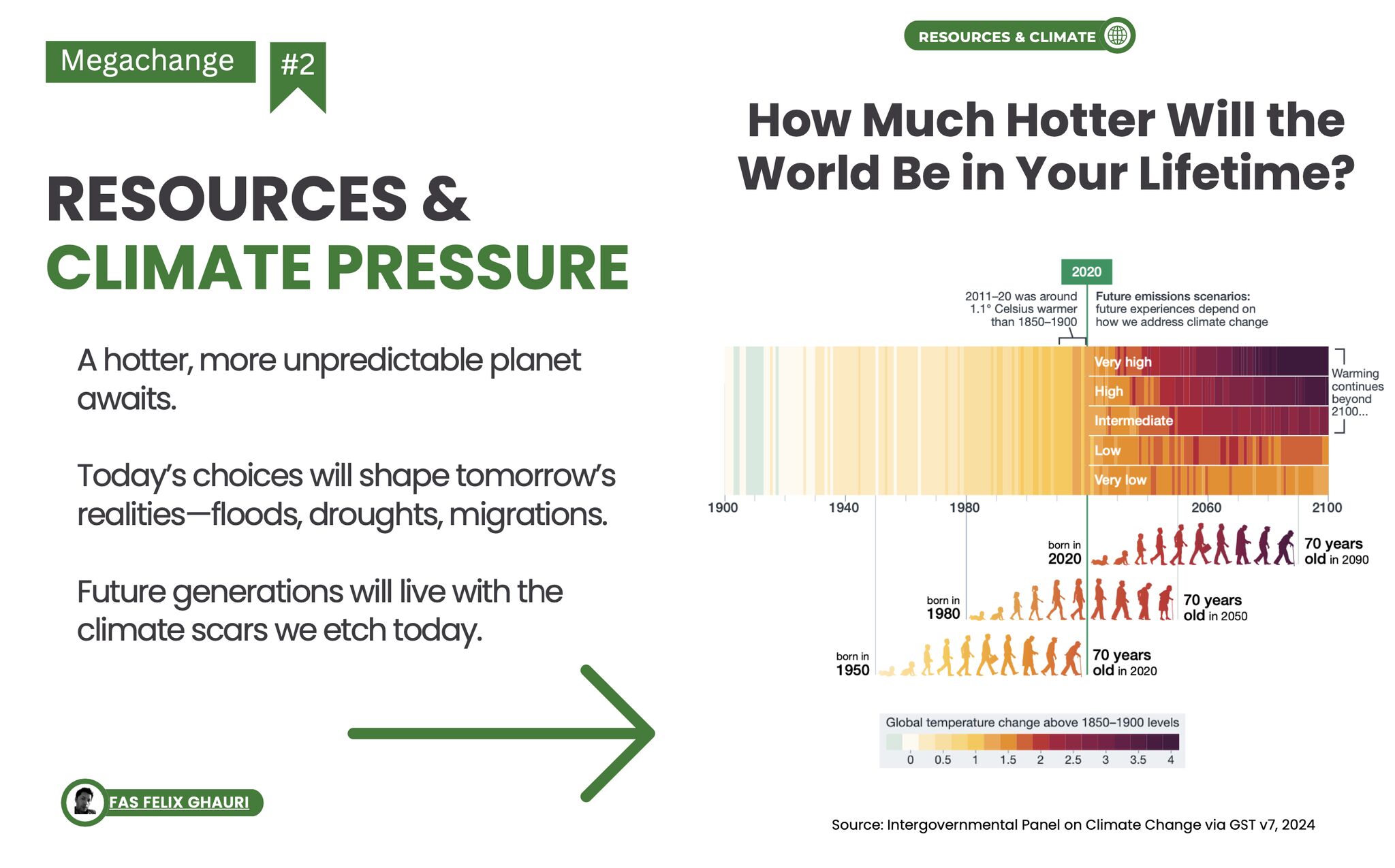
Most people see the strain on our planet’s resources—but have you stopped to consider just how much hotter and more unpredictable life could become within your own lifetime?
The fragile balance of climate and resources is tipping, reshaping the systems we rely on for life, work, and progress:
-
🔥 Rising Temperatures: By 2100, the world could be 3°C hotter than pre-industrial levels, disrupting agriculture, infrastructure, and daily life.
-
💧 Water Scarcity: By 2055, 60% of humanity could face water stress, turning this basic necessity into a geopolitical issue.
-
⛏️ Critical Minerals: Green energy demands triple the resources of fossil fuels, concentrating power in nations rich in rare earths.
-
🌪️ Extreme Weather: Floods, heatwaves, and droughts are the new normal, displacing millions and straining global economies.
But it doesn’t stop there: these pressures intersect with demographic shifts, technological innovation, economic transformation, and geopolitical realignments.
-
🏠 Migration Pressures: Climate change drives migration as rising seas and drought reshape population centers.
-
🌍 Global Tensions: Resource scarcity fuels geopolitical tensions and economic inequalities.
-
⚙️ Energy Innovation: The transition to green energy demands new technological breakthroughs and resilient supply chains.
-🌱 Shared Spaces: Oceans, forests, and other global commons are straining under rising consumption and ecological collapse.
Thriving in this era begins with an understanding of these dynamics and the foresight to adapt. Leaders who think systemically will not just survive but shape the future.
How are climate and resources pressures reshaping your industry?
…
This post is part of a series on the 5 Revolutions driving megachange—key forces reshaping our world:
• Megachange: https://lnkd.in/d2Fq-NiJ • 5 Revolutions: https://lnkd.in/d28vz9bW • #1: Demographic Shifts: https://lnkd.in/euAt79Ay
…
#megatrends #future #foresight #strategy #leadership #transformation #Innovation #sustainability #energy #climatechange with thanks to World Resources Institute, The World Bank, OECD - OCDE, International Energy Agency (IEA), McKinsey & Company, Deloitte, UN Environment Programme, MIT Energy Initiative, Stanford Woods Institute for the Environment